
Ponza and the Pontine Islands: 7 Exclusive Coves for Late Summer
A Ponza yacht charter is the way to reach the Pontine Islands, a small archipelago off Italy’s western coast that has no airport and only limited ferry service from the mainland. Late summer is the best window to go: the crowds thin out after mid-August, the water is at its warmest, and the coves that are packed in July are quiet again.
In this guide:
- Where the Pontine Islands Are
- A Ponza Yacht Charter Guide to the Best Coves
- Palmarola
- Ventotene & Santo Stefano
- Logistics for Brokers
- Best Time to Go
- Insider Tips
- Chartering With Silver Star Yachting
Where the Pontine Islands Are, and Why Late Summer?
The Pontine Islands sit in the Tyrrhenian Sea, roughly 25 to 50 nautical miles off the coast between the Gulf of Gaeta and Cape Circeo, closer to Rome than to Naples but comfortably reachable from both. The archipelago is made up of six islands: Ponza, the largest and only one with a proper harbour town, Palmarola, Zannone, Ventotene, Santo Stefano and the tiny islet of Gavi. None of them has an airport, and the ferry timetable is thin enough that most visitors who reach these islands arrive by private boat, which keeps the anchorages genuinely uncrowded compared with the Amalfi Coast or Capri.
July and the first half of August bring day-trippers from the mainland and a busy harbour in Ponza town. By the last two weeks of August and into September, that traffic drops off sharply while the sea temperature is still at its summer peak, which is what makes late summer the window worth building an itinerary around.
Getting There: Naples, Ischia, Gaeta and Rome
A charter typically starts from a base in the Gulf of Naples or Ischia, with Ventotene the first landfall roughly 18 to 20 nautical miles out, then Ponza another 20 nautical miles beyond that, and Palmarola a short 8 nautical miles further west. Charters starting further north, from Rome’s port at Civitavecchia or from Gaeta, reach Ponza in a single day’s run, which makes the islands a natural add-on to a Rome-based itinerary as well as a Naples one.
Because Ponza and its neighbours have so little in the way of shops or supply boats, most crews provision fully in Naples or Ischia before setting out. It is a detail worth building into any Ponza yacht charter itinerary rather than assuming it can be sorted on arrival.
A Ponza Yacht Charter Guide to the Island’s Best Coves
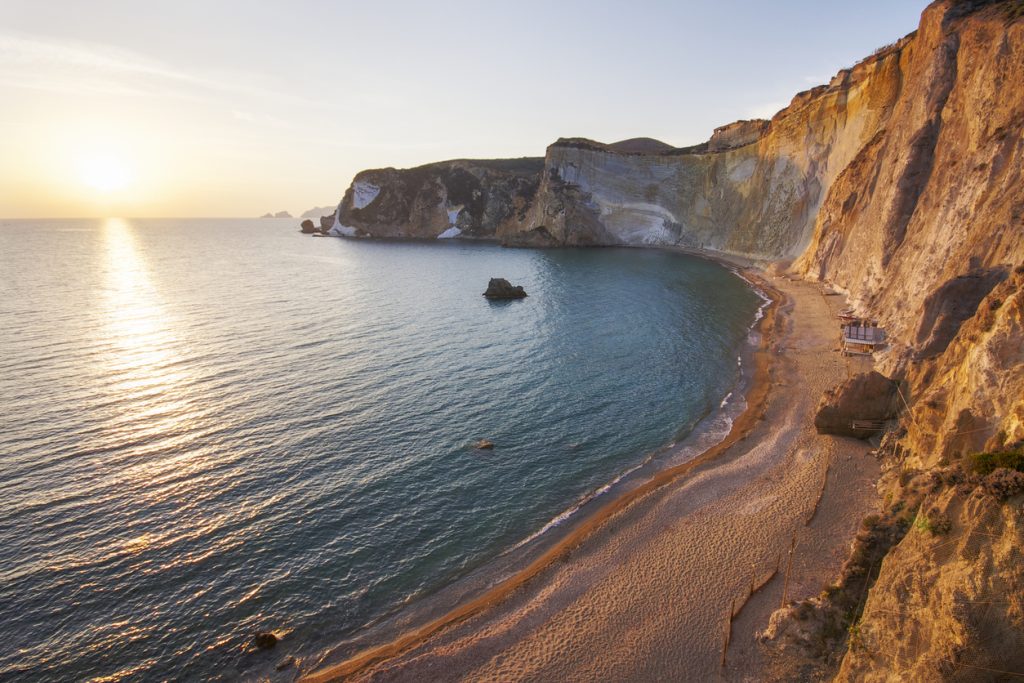
Ponza gives its name to the archipelago and is the only island with a real village to explore ashore. The coastline alternates rocky headlands, sea arches and small coves that are only reachable by boat, which is most of the appeal of a Ponza yacht charter in the first place.
Chiaia di Luna
The island’s largest and best known beach is a crescent of pale sand set beneath sheer cliffs of white tufa, the same volcanic rock that shapes most of the island. For centuries the only way in was a Roman-era tunnel cut straight through the cliff, and that passage is still part of what makes arriving here by tender, rather than on foot, the better approach.
Cala Feola and the Volcanic Pools
Near Le Forna, on the western side of the island, wind and sea have carved a set of shallow pools directly into the tufa rock. The water here is unusually clear even by Ponza’s standards, and the rocky seabed draws divers as much as swimmers.
The Harbour Village and the Piazzetta
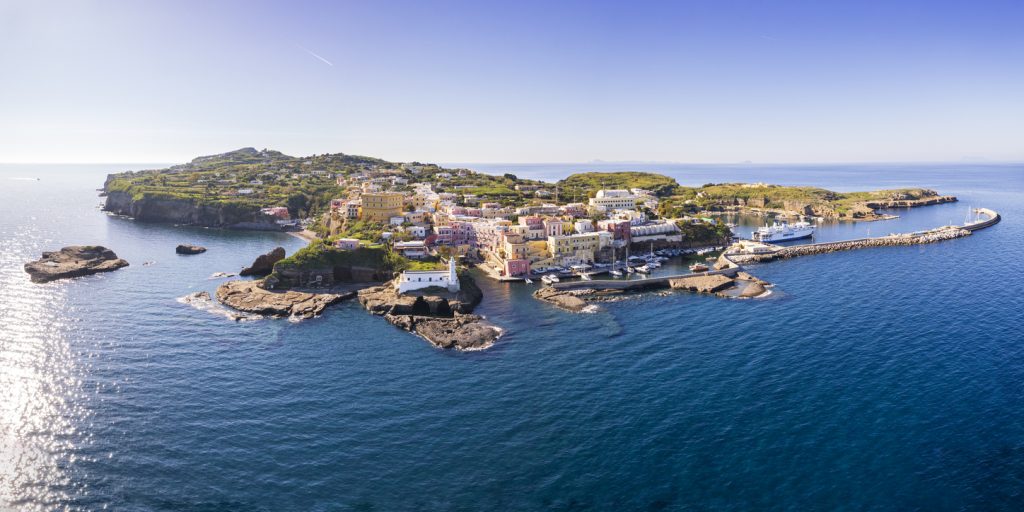
Ponza’s main settlement, known locally as Porto, wraps around a natural harbour lined with pastel-coloured houses and terraced fields climbing the slope behind. Car traffic is limited, so the waterfront stays quiet even in high season, and the small piazza above the port is where the town’s evening life actually happens. Roman-era remains, including a breakwater and the foundations of villas built when the island was a seaside retreat for Rome’s ruling families, are still visible along parts of the coast. Julia Livilla, sister of the emperor Caligula, was exiled here twice, a detail that gives the island’s quiet, present-day charm an odd historical edge.
Palmarola: The Wildest Neighbour
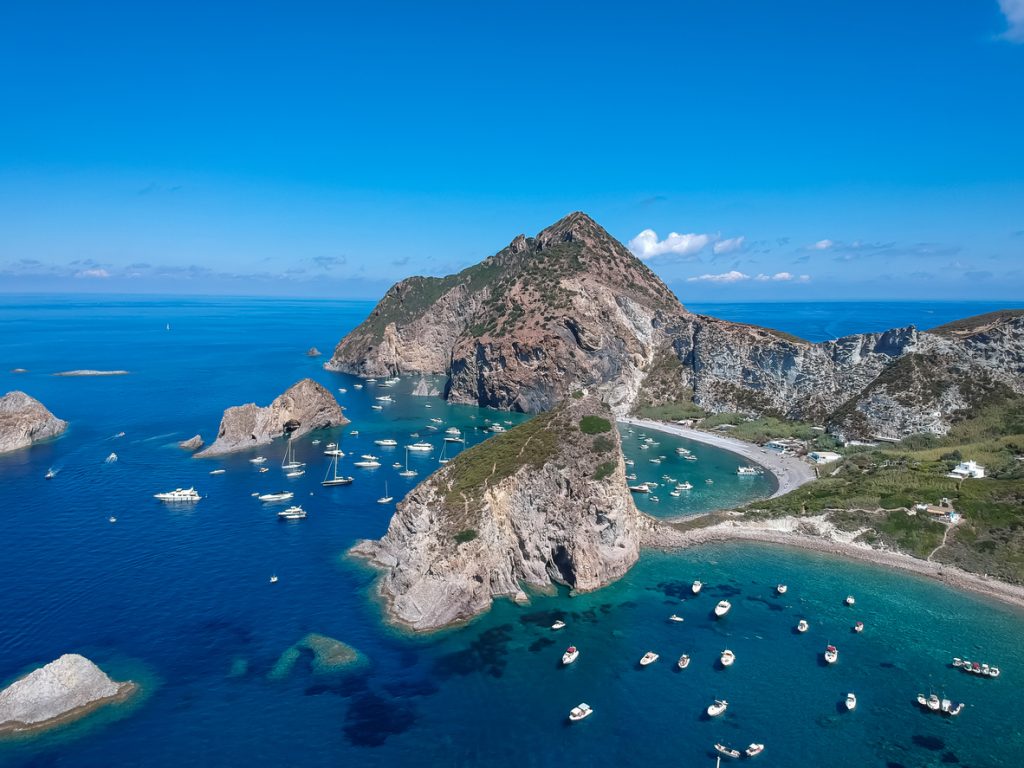
Eight nautical miles west of Ponza, Palmarola has no permanent population and almost no infrastructure. Its one pocket of summer activity is Cala del Porto, a bay with a handful of rock-cut houses, a bar and a restaurant that opens only for the season; everywhere else on the island is empty coastline. The volcanic cliffs on its western side, often described as cathedral-like, and the near-total absence of development are why brokers who know the region tend to treat a Palmarola stop as the highlight of a Pontine itinerary rather than a side trip.
Ventotene and Santo Stefano: Rome’s Exile Islands
Further south, Ventotene and the smaller Santo Stefano form a state marine reserve, which means the surrounding waters are protected and mooring is more tightly managed than around Ponza. Ventotene was a place of exile under the Roman empire, and Santo Stefano is best known for a former island prison that operated for well over a century before it closed. Between the two, the diving is considered some of the richest in the archipelago, with dense Posidonia meadows and, occasionally, loggerhead turtles.
Zannone, the northernmost of the six islands, is smaller still and geologically distinct from the rest of the archipelago: unlike its volcanic neighbours, it is partly made of far older metamorphic rock. It has belonged to Circeo National Park since 1979 and is largely left to its bird colonies, with the ruins of a 12th-century monastery its only real trace of past habitation.
Logistics Brokers Should Flag Early
A few practical points are worth raising with clients before they commit to dates. Berths in Ponza’s harbour are genuinely scarce in peak weeks, and demand for the best slots starts well before the season opens, so this is not a booking to leave until the last minute. Around Ventotene and Santo Stefano, the marine reserve imposes its own mooring and no-anchor zones, which means a route through that stretch needs to be planned rather than improvised on the day.
Best Time for a Late Summer Charter
The last two weeks of August through late September is the sweet spot: sea temperatures are still in the high 20s Celsius, the mainland’s summer holiday traffic has largely gone home, and anchorages at Chiaia di Luna or Cala del Porto that are elbow to elbow in July open back up. Wind patterns in the Tyrrhenian are generally gentler in this window too, which matters for a comfortable crossing to Palmarola or Ventotene.
Insider Tips for Visiting Ponza and the Pontine Islands
- Anchor at Palmarola for lunch, not just a photo stop. Guests who only stop for an hour tend to regret not building in more time here.
- Bring snorkel gear you actually want to use. The sea caves around Ponza reward guests who get in the water rather than viewing them from the tender.
- Bookend the islands with Ischia or Procida. Both make a natural stop either side of the Pontine leg and add variety without adding much transit time.
- Ask your broker about Santo Stefano access early. As a protected islet, visiting arrangements can be more limited than the main islands, so it’s worth confirming before the itinerary is finalised.
Chartering the Pontine Islands With Silver Star Yachting
The Pontine Islands reward local knowledge more than most Italian charter grounds. Berths in Ponza’s small harbour are limited and go quickly in peak weeks, permits and mooring rules around the Ventotene and Santo Stefano marine reserve need to be worked out in advance, and the best anchorages at Palmarola are only obvious if someone has been there before. Being based in the Gulf of Naples, within a day’s run of all six islands, is what lets Silver Star Yachting plan this stretch of coast properly rather than treating it as an afterthought to an Amalfi Coast week.
You may also read:
- Sailing from Athens: 7-Day and 2-Week Sailing Itineraries
- Where to Charter in 2027 If You Want to Avoid the Crowds?
- Why Build Your Athens Sailing Itinerary Around the Saronic Gulf and Cyclades
- What Does a MYBA Charter Contract Actually Protect You From?
- Everything You Need To Know About The Advance Provisioning Allowance


